
The Missing Link in Diastasis Recti Healing: Why You Need to Breathe Better, Not Crunch Harder
PELVIC HEALTHWELLNESSMINDFUL MOVEMENT
Jodi Bremner PT, Founder of Hervana Women's Wellness
5 min read


___________________________________________________________________________________________________
If you’ve spent any time Googling "how to fix my postpartum belly," you’ve likely been met with a sea of conflicting advice. You’ve probably seen the term Diastasis Recti (DR) pop up, the separation of those front abdominal muscles, and perhaps you’ve felt that familiar pang of frustration. Maybe you’ve tried every "core-safe" workout on YouTube, or perhaps you’ve been avoiding movement altogether, fearful that you’ll make "the gap" worse.
There is a common misconception that healing Diastasis Recti is about closing a physical door. We are told to "knit the muscles back together," as if our bodies were simply a piece of fabric that has unraveled. This often leads us straight to the "crunch", that classic exercise we think will pull everything back to the center.
But here is the gentle truth: Healing is not about the crunch. It is about the breath.
At Hervana Women’s Wellness, we see women every day who are doing "all the right things" but aren't seeing the results they hoped for. They are still experiencing that "doming" or "coning" when they lift their children, or they feel a persistent sense of weakness in their core. The missing link is almost always how they are managing internal pressure, and that starts with a Spacious Breath.
__________________________________________________________________________________________________
Understanding Your Inner Canister
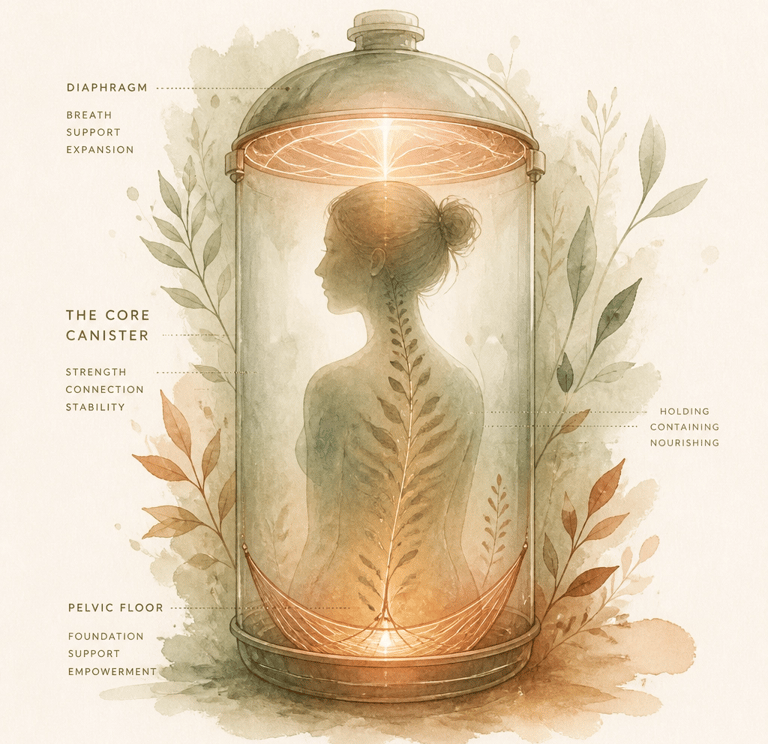
To understand why breathing matters more than crunches, we first have to look at how your core actually functions. Think of your torso as a beautifully coordinated pressure canister.
The Top: Your diaphragm (the main muscle for breathing) sits just under your ribs.
The Bottom: Your pelvic floor sits at the base of your pelvis like a supportive hammock.
The Sides: Your deep abdominal muscles (the transverse abdominis) and back muscles wrap around you like a corset.
___________________________________________________________________________________________________
___________________________________________________________________________________________________
When this canister is working in harmony, your breath and your core muscles dance together. As you inhale, your diaphragm moves down, and your pelvic floor and abdominal wall gently lengthen to make room. As you exhale, your diaphragm moves up, and your pelvic floor and core naturally lift and gather.
Diastasis Recti happens when the connective tissue between your "six-pack" muscles (the linea alba) becomes stretched and thin, most commonly during pregnancy. This means the front of your "canister" isn't as firm as it used to be. When you move, lift, or even breathe shallowly, the internal pressure has to go somewhere. If that pressure isn't managed well, it pushes right against that weakened midline, causing it to bulge outward.
___________________________________________________________________________________________________
The Trouble with Crunches
When we perform a traditional crunch, we are creating a massive amount of internal pressure. If your core hasn't yet learned how to distribute that pressure, it takes the path of least resistance. Usually, that means the pressure is driven straight forward into your Diastasis Recti (creating that "coning" look) or straight down onto your pelvic floor.
Doing crunches to heal a Diastasis is like trying to fix a leaky pipe by turning up the water pressure. Before we add the "load" of a crunch, we must first ensure the "pipes" (your breath and pressure management) are working correctly.
This is where pelvic floor physiotherapy becomes a vital part of your journey. It’s not just about strength; it’s about coordination and safety.
___________________________________________________________________________________________________
___________________________________________________________________________________________________
Finding Your Spacious Breath: The 360-Degree Approach
Most of us have become "chest breathers" or "belly breathers." Chest breathing keeps us in a state of high tension (hello, neck and shoulder pain!), while pure belly breathing can actually put more pressure on a healing Diastasis.
The goal for healing is 360-degree breathing.
Imagine your ribcage is like an umbrella. When you inhale, the umbrella should open in every direction, not just forward into your belly, but out to your sides and back into your spine. This "Spacious Breath" allows the pressure to distribute evenly throughout your entire canister, taking the strain off your midline and allowing the tissue to heal.
When you master this breath, you aren't just healing a gap; you are regulating your nervous system. You are telling your body it is safe to let go of the "holding" and "clenching" patterns that often accompany Diastasis Recti and pelvic floor dysfunction. You can read more about this quiet connection here.
___________________________________________________________________________________________________
___________________________________________________________________________________________________
A Simple Practice to Try
Healing begins with awareness. Take a moment today to reconnect with your "canister" and find your own spacious breath.
Find Your Sanctuary: Sit or lie down comfortably in a quiet space where you feel safe.
Hand Placement: Place your hands on the sides of your lower ribs. This is where we want to feel the most movement.
The Inhale: Breathe in slowly through your nose. Imagine the air traveling deep down, but instead of just pushing your belly out, try to push your hands out. Feel your ribs expand sideways and into the back of your chair or the floor.
The Softening: As you inhale, imagine your pelvic floor widening and softening, like a flower opening its petals.
The Exhale: Breathe out through your mouth as if you are blowing through a gentle straw. As the air leaves, feel your ribs draw back in. You might notice a very subtle, natural "lifting" sensation in your pelvic floor and a gentle "zipping up" of your lower tummy.
Gentle Presence: Don't force the movement. Let it be a soft, rhythmic wave.
Repeat this for 5–10 breaths. This is the foundation of your core recovery.
___________________________________________________________________________________________________
Moving Beyond the Gap
At Hervana, we believe that your body is not "broken", it has simply adapted to the incredible journey of motherhood or the shifts of life. Healing Diastasis Recti isn't just a physical goal; it’s a path toward reclaiming your strength and confidence.
If you are feeling overwhelmed by your DR journey, or if you’ve been told you "just have to live with it," please know there is another way. Whether you are seeking postpartum pelvic floor physiotherapy or simply looking for a restorative experience to reconnect with your body, we are here to walk beside you.
You don't need to crunch harder. You just need to breathe deeper.
___________________________________________________________________________________________________
Let’s help you find your room to breathe.


Quick Links
© 2026 Hervana Women's Wellness. All rights reserved.

Jodi Bremner PT
Follow Us
jodi@hervanawomenswellness.ca
(902) 907-4061
Services are offered in partnership with other beautiful Nova Scotia spaces.
Pelvic Physiotherapy
At Berwick Chiropractic Health & Wellness
188 Commercial St, Berwick, NS
(902) 538-5005 | Book Online ›




Stay Connected